
Elderberries MUST BE COOKED before consuming.
By Ramona Slick
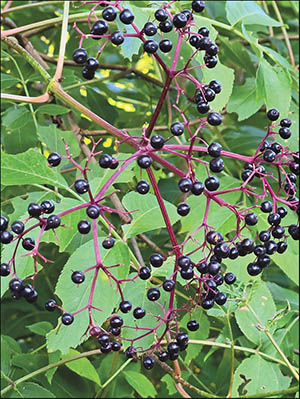
Our local native Elder (Sambucus canadensis) is considered a subspecies of the European Black Elder (Sambucus nigra) now classified in the family Adoxaceae which includes several subspecies of Sambucus along with viburnums.
Elders are multi-stemmed woody shrubs growing 8-12 ft. tall and wide. Stems have large piths that become hollow as they mature. Stems live about 5 years., but new shoots arise from the crown which also sends out root suckers that are shallow-rooted and easily propagated.
Typically growing in roadside ditches, near creeks and forest edges, I’ve grown elders quite successfully in full sun on the downside of our horse corral, where “manure tea” from rainfall flowing downhill fertilizes our elder hedgerow. Leaves are compound, pinnate with 5 to 9 toothed edge leaflets about 4″ long and a deep green.
Tiny white 5-petalled flowers bloom early summer in a flat-topped cluster (more on flowers in subsequent series). Dark purple berries smaller than a pea are born in clusters starting in July in our area but abundantly in August-September as one travels north. Elders love compost in soil that holds moisture but must drain decently and not stay soggy.
Elder harvest is best done by clipping the cluster head with as little stem as possible into a bag and then into the freezer for ease of removal for processing. Elderberry stain has been used for dye so you may want to wear gloves. They can be dried (low temp) for later use or kept frozen but MUST BE COOKED before consuming. As berries, stems, and leaves contain cyanogenic glycosides (poisonous) which can cause severe nausea /vomiting. Bring to a low boil, simmer 30-45 minutes in an open pan, or can be baked in various recipes.
Ramona Slick, a Garland County Horticulture Agent and GC Master Gardener, volunteers with GC Master Gardeners of the UofA Div. of Agriculture, Cooperative Ext. Service. Master Gardeners pool skills and resources to improve home horticulture, stimulate interest in plants and gardening, and encourage beautification. For more info, call 501-623-6841, email ashaffer@uada.edu, or visit FB: GarlandCountyMasterGardeners.