

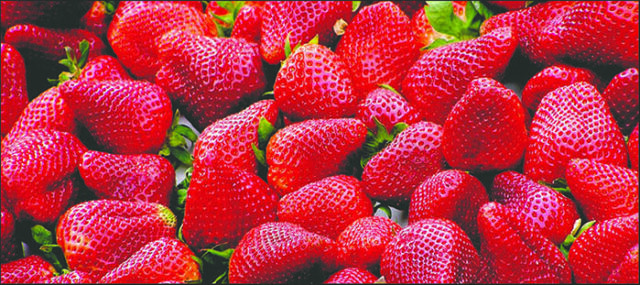
Strawberries, like other berries, are rich in vitamins, minerals, fiber, and compounds with antioxidant and anti-inflammatory properties.
By Alison Crane
Did you know that according to the U.S. Department of Agriculture, each person consumes five pounds of strawberries annually?
Given that much consumption, it’s good that strawberries are grown in every state in the U.S. and every province in Canada. In Arkansas, strawberry season is from late April through the month of May.
Select fully ripe strawberries with a natural shine, rich red color, bright green caps, and a sweet smell. White or pale pink berries do not become sweeter after they are picked and should not be purchased. Strawberries with bruises or without caps do not store well and should not be purchased.
Refrigerate strawberries immediately after purchase in the original container or an airtight container lined with paper towels. Never rinse the berries or remove the caps when storing. Strawberries can only be stored for a couple of days in the refrigerator. Strawberries taste best at room temperature.
Freezing strawberries whole is an easy way to maintain shape and nutrition. Gently blot the berries dry after thoroughly rinsing. Slice off the stem at the top of the berry and place the cut side down on a cookie sheet lined with waxed paper. Place uncovered in freezer for a minimum of 6 hours.
Once completely frozen, transfer berries to a freezer bag or container and label with the date. Frozen strawberries can be stored frozen for several months.
Strawberries make an excellent topping for pancakes and waffles, and add nutritional value and flavor to cereals. They are a great snack, a good addition to salads, and crushed strawberries are often added to lemonades or teas. Strawberries can be added to yogurt for parfaits or put in a blender for smoothies.
Fun strawberry facts: an average strawberry has about 200 seeds on the outside, which technically means they are not true berries. Berries have their seeds on the inside of the fruit. Each “seed” on the outside is actually classified by botanists as a separate fruit, each containing its own seed.
Strawberries, like other berries, are rich in vitamins, minerals, fiber, and compounds with antioxidant and anti-inflammatory properties. Strawberries have high levels of nitrate, which increases blood and oxygen flow to the muscles. Eating strawberries before exercising can improve endurance and help to burn more calories. Eight strawberries provide 140% of the daily recommended Vitamin C for kids.
Strawberries are low in calories, only 32 calories per half cup. A serving of strawberries is about four large berries or eight medium ones. One pound of strawberries averages about three to four servings, making it a great low-cost fruit to serve your family.
To learn more about making the most of fruits and vegetables when they are in season, contact the Garland County Extension Service at 501-623-6841 or email acrane@uada.edu for upcoming programs and available resources. Enjoy your strawberries for their nutritional value and as a tasty treat!
Alison Crane is a Family and Consumer Sciences Agent with the Garland County Extension Service. Pursuant to 7 CFR § 15.3, the University of Arkansas System Division of Agriculture offers all its Extension and Research programs and services (including employment) without regard to race, color, sex, national origin, religion, age, disability, marital or veteran status, genetic information, sexual preference, pregnancy, or any other legally protected status, and is an equal opportunity institution.