
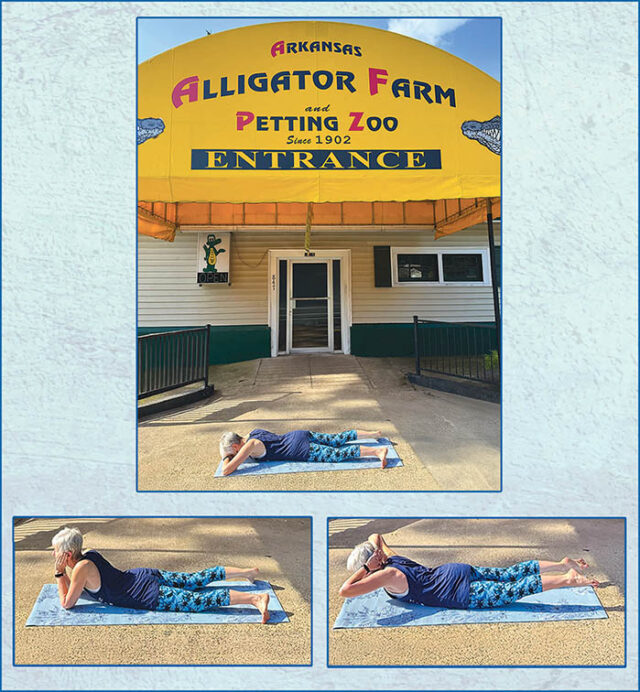
Karen Watson Reeves demonstrates three variations of Crocodile Pose. Photos by Lynn Janaskie.
By Karen Watson Reeves
[Contributor’s note: 2025 is the year we celebrate 12 years as The Yoga Place, and this calendar year, the setting for each month’s pose will be a business in our town that has exhibited “stay power.”]
To my knowledge, there is no alligator pose in yoga, but there is a crocodile pose (with lots of variations). And since both alligators and crocodiles are reptiles, there are some similarities, so we are putting that Crocodile Pose right in front of the Alligator Farm and calling it close enough! Because in our end of town, “alligator pose” must be done in front of the legendary Alligator Farm and Petting Zoo.
Crocodile Pose is one that I have primarily taught in children’s yoga classes, which always contain a lot of playful imagination. We begin as in the first photo, with our crocodile heads down in the water. Then, as in the second photo, the croc brings its head up a bit, and finally, in the last photo, its head and neck are above the surface.
Not pictured is a final thing we do: with the head still lifted up, the arms extend forward with palms together; then the hands separate and press together with a clap, as the croc snaps at its victim. All is fair in crocodile/alligator subsistence and in imaginative play time in children’s yoga, right?
From the belly-down position, the body can relax, the mind calms, fatigue is relieved. Other benefits of this posture include releasing lower back compression, stretching the hip muscles, and relieving sciatic pain.
Crocodiles and alligators have hard backs and soft bellies, but the strength of these reptiles lies in their abdomen. The hard backs provide protection from external attacks, while the soft belly supports the hardback. While in the prone position, humans are quite aware of their bellies. Practicing the deep abdominal breathing is more challenging, but while we do we find our power strengthened as we persevere. So, the opposite values (hard/soft . . . challenging/powerful) are complementary. A good life lesson, I think.
I’m not sure if adult classes will condone the tom-foolery of the Crocodile Pose sequence of variations and get into the playfulness of the posture. But who doesn’t need some life lessons and fun?
{Arkansas Alligator Farm & Petting Zoo, located at 847 Whittington Avenue, opened in 1902 and has been operated by the same family through three generations since 1947.}
Karen Watson Reeves has called Hot Springs home since 2006. Owner of The Yoga Place, at 301 Whittington Avenue, she became a registered yoga/children’s yoga teacher in 2011. When not on the mat, Karen enjoys the beautiful outdoors of the National Park, especially from her bicycle. Please find more information about her studio and her schedule of classes at www.theyogaplacehs.com.