
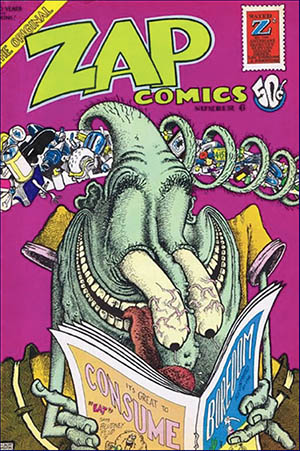
Boomers found solace in Robert Crumb’s Zap Comix.
By David Malcolm Rose
Crystal Bridges features a long wall of large, simplistic canvases. Every museum that touches on Modern Art has a similar collection. Color field paintings by Clyfford Still and Mark Rothko are a must. One of Barnett Newman’s stripes, Stella’s geometric patterns, Gottliebe’s floating shapes, a thinly stained, and a blank canvas usually round out the field. These paintings date from the 1950s to the mid-1970s.
The 1950s through the mid-1970s is also when the 60s generation was becoming aware and beginning to interact with their world. Consider the events of that era; THE BOMB, duck & cover, Cold War paranoia, Rosa Parks, Bay of Pigs, Cuban missile crisis, JFK assassinated, LBJ ramps up the Vietnam War and the military draft, hundreds of thousands protesting the war and calling for civil rights, uprisings leave cities in ashes, Martin Luther King and RFK assassinated, students bleed out at Kent State.
For us, these were not abstract times, and those aforementioned paintings did not reflect our experiences. We found solace in album covers, DayGlo posters, and Robert Crumb’s Zap Comix.
Fast forward 50 years. Many of those who made it to retirement had copious disposable income and started putting it into art, but not out of a lifelong love. They tended to do it more as an investment, a tax write-off, or for the status it could bring. They wanted spectacle, something they could point at, some bling.
More money than ever before is now pouring into the world of Art. It goes in at the top and, for the most part, stays there. The entry points for the system are few. Hot Springs, to its credit, still has independent galleries. Come out and support them on Friday’s gallery Walk.
David Rose shows his art at Collective Arts Gallery, upstairs at 620 Central Avenue, in downtown Hot Springs.