
By Lana Pierce
As a 20-year career firefighter, I could build a calendar around the fire types we run. January and February, chimneys and vehicles; May through July, fireworks and barbeques; September and October, leaves and heaters. But November and December bring the big ones: ovens, candles, and extension cords.
Let’s talk turkey: Baked in the oven or fried outside, the method of cooking is not as important as the attention span of those doing the cooking. Set timers, tell relatives to keep an eye on the oven (or frypot), and don’t panic if a kitchen fire erupts.
For grease fires, cover the flames with a metal or glass lid (grease fires are put out by starving the flames of oxygen). Keep children and drunk uncles away from knobs on stoves since a little bump can cause a big problem. Small kitchen extinguishers are a must-have and are available in several stores around Hot Springs.
As much as I hate this next rule, it took just a fatal fire or two to convince me that snoozing with a burning candle in the room is a terrible idea. If you have pets or a spouse who tosses covers like they’re throwing discus in the Olympics, this is especially important.
Incipient fires (little fires in the beginning stages) are easy for many people to sleep through. If a fire stays small enough, some people sleep as they are overcome by gases—literally sleeping through a housefire or, worse, waking up just in time to realize they are trapped.
Extension cords are, in my opinion and experience, as dangerous as the first two combined because they don’t look hazardous. They’re an everyday part of our lives, year-round. In a nutshell, the smaller and cheaper the extension cord, the more probable the overload, the fraying, and the risk for sparking.
A fire beginning in an outlet might go unnoticed until it has traveled through the interior of a wall, burning the “skeleton” of your home, as we call it. It’s worth the time to research your cord’s capabilities and its limitations.
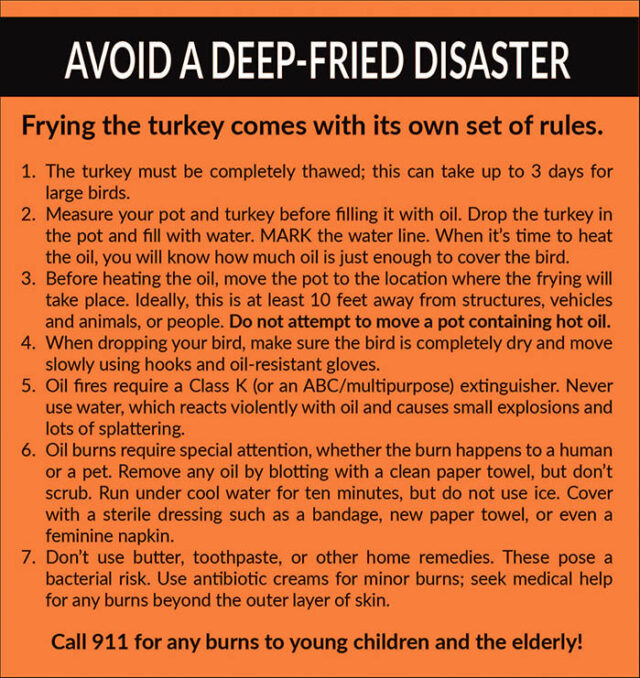
Frying the turkey comes with its own set of rules.
- The turkey must be completely thawed; this can take up to 3 days for large birds.
- Measure your pot and turkey before filling it with oil. Drop the turkey in the pot and fill with water. MARK the water line. When it’s time to heat the oil, you will know how much oil is just enough to cover the bird.
- Before heating the oil, move the pot to the location where the frying will take place. Ideally, this is at least 10 feet away from structures, vehicles and animals, or people. Do not attempt to move a pot containing hot oil.
- When dropping your bird, make sure the bird is completely dry and move slowly using hooks and oil-resistant gloves.
- Oil fires require a Class K (or an ABC/multipurpose) extinguisher. Never use water, which reacts violently with oil and causes small explosions and lots of splattering.
- Oil burns require special attention, whether the burn happens to a human or a pet. Remove any oil by blotting with a clean paper towel, but don’t scrub. Run under cool water for ten minutes, but do not use ice. Cover with a sterile dressing such as a bandage, new paper towel, or even a feminine napkin.
- Don’t use butter, toothpaste, or other home remedies. These pose a bacterial risk. Use antibiotic creams for minor burns; seek medical help for any burns beyond the outer layer of skin.
Call 911 for any burns to young children and the elderly!
Let the turkey be tender, the drama be light, and your pants forgiving.
Lana Pierce is a grizzled- old fire-head with NLRFD and is Captain on Engine 10, “the dirty dime.”