
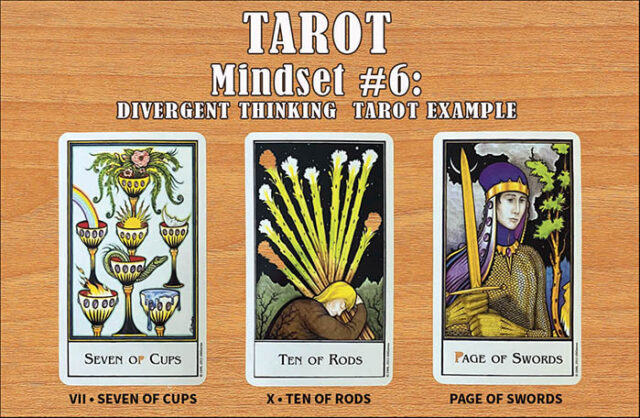
These three cards would have different meanings in a Past – Present – Future spread vs. a Mind – Body – Spirit spread. Meanings also vary based on the question asked of the cards.
By Michelle Crandell
“How is a bird like a shoe?” “How is a pot like an angel?” “List seven uses for a brick.” The process of coming up with responses to these prompts is called divergent thinking. This way of thinking helps a person become more open-minded, imaginative, and mentally flexible.
Practicing divergent thinking improves your ability to “think out of the box,” notice commonality among seemingly unrelated things, and solve problems more creatively.
Brainstorming, seeing faces and figures in clouds, taking an improv class, or learning to read Tarot cards are some ways to develop the ability to think divergently.
In Tarot, it is vital to “read each card as it shows up in the reading.” Interpret each card within the context of the reading: the card’s position, the question asked, the kind of spread being used, and the influence of other cards in the reading.
A proficient Tarot reader uses divergent thinking to see connections between cards and present the story the reading is telling. Even one card, such as the Queen of Cups, for example, could represent a loving, maternal figure, the person requesting the reading, or someone who can offer good advice on matters of the heart, or the attitude needed to solve a particular problem. The specific meaning is interpreted using divergent thought and intuition.
Most Tarot decks come with an interpretation book. Use it to confirm or augment your perceptions rather than replace them. Use it last, not first.
Michelle Crandell provides individual Tarot readings for a fee. Once a year, she teaches LEARN TO READ TAROT. Call if interested in her next class. To learn more, email michelle.crandell@gmail.com or call 501-655-6242.